moving-to-gibraltar · Last updated 2 June 2026
Gibraltar vs Malta for Relocation: Which Is the Better Choice in 2026?
 •
• 
Gibraltar offers no VAT, no CGT, no IHT, a 15% corporate tax rate (as of July 2024), and the landmark 15 July 2026 EU border treaty. Malta offers full EU membership, more housing diversity, and a larger expat community. For British nationals especially, Gibraltar wins on simplicity; Malta wins on size and EU access that it has always had.
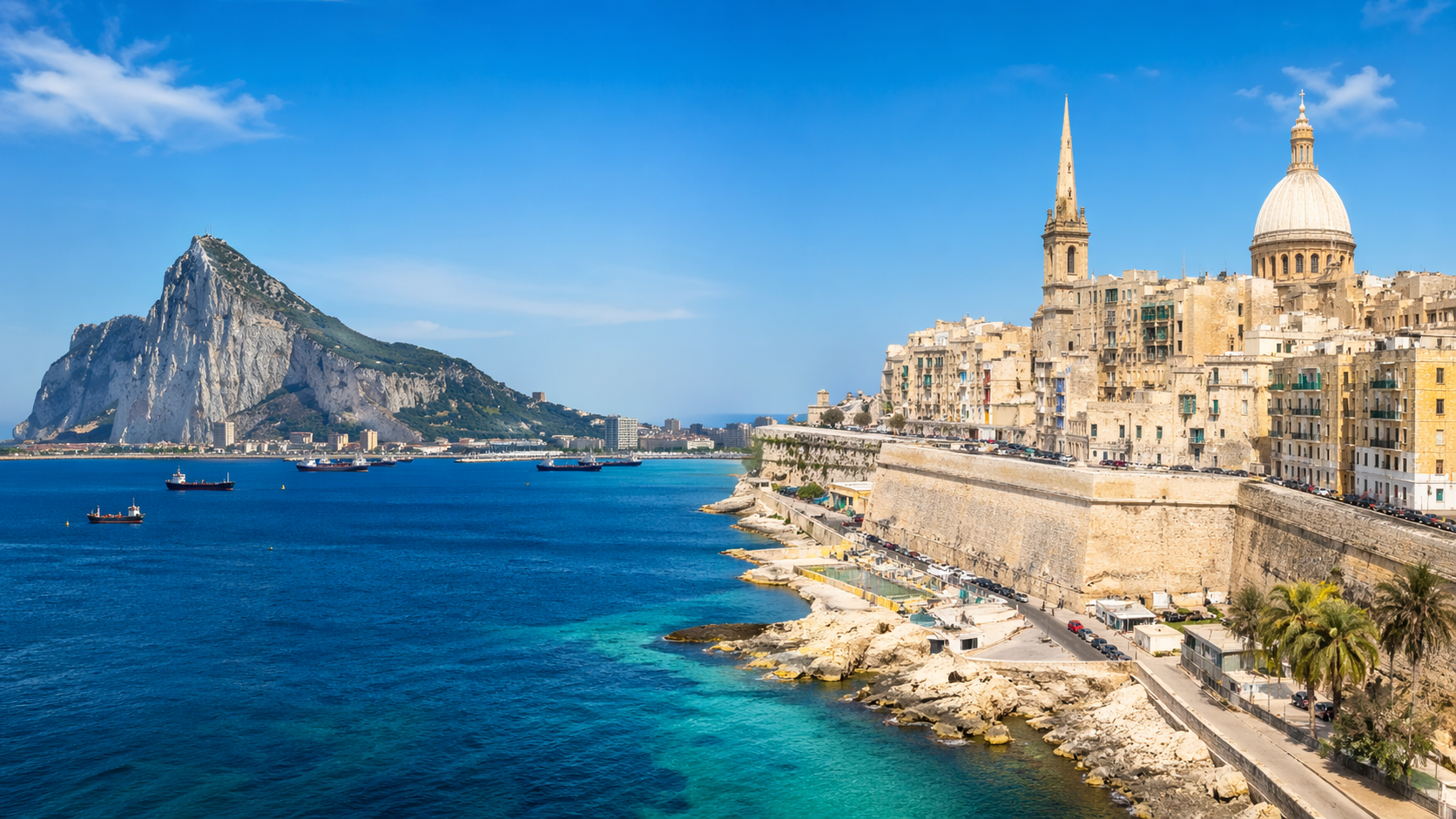
Gibraltar and Malta come up in the same conversation constantly. Both are English-speaking, both offer competitive tax environments, and both attract the same type of relocator: professionals, remote workers, and entrepreneurs who want EU adjacency without a heavy tax burden. But they are quite different places to actually live. Here is the honest comparison.
Quick Summary
- Gibraltar wins on tax simplicity, no VAT, UK legal framework, and the 15 July 2026 EU border deal
- Malta wins on EU membership, more housing options, and established expat infrastructure
- Gibraltar is physically tiny with limited rental stock and higher rent-to-size ratios
- The July 2026 Gibraltar-EU treaty closes the main EU access gap that previously favoured Malta
Tax: Where Does Your Money Go Further?
This is usually the deciding factor. Both jurisdictions offer genuinely competitive tax environments, but they work differently.
| Factor | Gibraltar | Malta |
|---|---|---|
| Income tax rate | Up to 29% (standard) or flat fee via Category 2 | Up to 35% (standard) or Malta Non-Dom scheme |
| Capital gains tax | None | None on most assets |
| Inheritance tax | None | None |
| VAT | None | 18% standard rate |
| HNW scheme | Category 2: minimum £37,000 / maximum ~£42,380 annual tax (as of May 2026) | Malta Non-Dom: minimum annual tax applies (public sources indicate ~€15,000) |
| Corporate tax | 15% flat rate (since July 2024) | 35% headline rate; effective rate reduced via refund mechanism |
Verdict: Gibraltar is simpler and more transparent. No VAT, no capital gains tax, no inheritance tax. Malta's corporate refund structure is well-established but involves more complexity. For high earners, Gibraltar's Category 2 status caps tax liability with a clear minimum of £37,000 and a ceiling of approximately £42,380 on the first £120,000 of assessable income (as of May 2026).
The July 2026 Treaty: A Gibraltar Game-Changer
This deserves its own section because it materially changes Gibraltar's position relative to Malta.
From 15 July 2026, Gibraltar's new treaty with the EU opens the border with Spain, allowing free movement between Gibraltar and the Schengen zone. Gibraltar residents will be able to cross into Spain and work across the EU without the friction that currently exists.
For years, the main argument against Gibraltar compared to Malta was EU access. Malta is a full EU member; Gibraltar is not. The July 2026 treaty closes much of that gap. Gibraltar residents will have Schengen access, cross-border work rights, and free movement into Spain and beyond. For anyone who works remotely or has business interests in continental Europe, this is a significant shift in the comparison.
Cost of Living
Both places are expensive by European standards, but in different ways. Cost comparison sources indicate Malta runs roughly 15 to 18% cheaper overall, though Gibraltar's zero-VAT environment offsets some of that gap on goods and services.
| Expense | Gibraltar | Malta |
|---|---|---|
| 1-bedroom apartment rent (central) | £1,200 to £1,800/month (public listings indicate) | €900 to €1,400/month (public listings indicate) |
| Groceries | Moderately expensive (UK-priced imports) | Moderate (mix of local and imported) |
| Dining out | Expensive (small market, limited competition) | Good variety, reasonable range |
| Healthcare | Free at the Gibraltar Health Authority (GHA) for residents | Free at public hospitals, good private market |
| Transport | Minimal need for a car (very walkable territory) | Car helpful; buses less reliable outside the main towns |
Housing: The Biggest Practical Difference
Gibraltar is 6.8 square kilometres. That is not a typo. The rental stock is genuinely limited, competition for good properties is real, and most apartments are compact by international standards. The market moves fast. Developments like Ocean Village and Europort represent the main modern residential stock, and supply does not match demand in the way it would in a larger city.
Malta is much larger with far more housing diversity. You can live in Valletta, St Julian's, Sliema, or quieter areas like Gozo. There is a proper range of price points and property types. If space and housing choice matter to you, Malta wins this category clearly.
Lifestyle and Feel
Gibraltar feels like a small British town that happens to be in the Mediterranean. That is genuinely appealing to some people and less so to others. The community is tight-knit, English is the primary language, and there is an authentic local culture that has developed over three centuries of British rule alongside Genoese, Moroccan, Jewish, and Spanish influences. Residents consistently describe low crime, sunshine for most of the year, beaches within easy reach, and a relaxed pace that larger cities cannot offer.
Malta feels more Mediterranean in character. Maltese is the national language (though English is widespread), the architecture is distinctly different, and there is a larger, more diverse expat population. Residents coming from the UK often comment on the volume of construction activity in certain parts of Malta, whereas Gibraltar's small size naturally limits new building.
Job Market
Gibraltar punches well above its weight in iGaming, financial services, and fintech. Salaries in these sectors are strong, and the territory's minimum wage sits at £9.50/hour as of July 2025, with professional and senior roles well above that. The job market is small and relatively specialised, and the iGaming sector has seen some corporate relocations to Malta in recent years, though Gibraltar retains a solid cluster of licensed operators.
Malta has a larger economy with more employment sectors, a sizable iGaming industry, and a more established international business presence. For anyone whose career falls outside the iGaming or financial services space, Malta offers a wider range of employer options.
Residency Process
Gibraltar's residency process is straightforward for British nationals, who have no visa requirement and no work permit requirements. For high-net-worth individuals, the Category 2 status is handled via the Gibraltar Finance Centre. Law firms including Hassans International Law Firm, ISOLAS LLP, and Triay (established 1905) regularly assist applicants navigating the process.
One important note for 2026: residency applications in Gibraltar were subject to a temporary suspension, reported in February 2026 alongside a broader property market realignment. Anyone planning to apply should confirm the current application status directly with the Civil Status and Registration Office (CSRO) at Joshua Hassan House, 2-8 Secretary's Lane, or with a local law firm before making firm relocation decisions.
Malta's residency programmes are well-documented and used by thousands of applicants annually, with multiple formal pathways available to EU and non-EU nationals alike.
The Bottom Line
Choose Gibraltar if you want a UK legal framework, simple tax structure, no VAT, no inheritance tax, no capital gains tax, and you work in iGaming or financial services. The 15 July 2026 treaty removes the main historical objection about EU access. The community is small, tight-knit, and offers a quality of life that larger cities struggle to match.
Choose Malta if you want full EU membership, more housing options, a larger expat community, and a more diverse job market. Malta's tax structures are competitive, though more complex to navigate than Gibraltar's straightforward flat-rate approach.
Frequently Asked Questions
Does Gibraltar have VAT?
No. Gibraltar has no VAT at all. This is one of its most significant practical advantages over Malta, where the standard rate is 18%, and over most EU countries.
Can I work in the EU from Gibraltar after the 2026 treaty?
The provisional application of Gibraltar's new EU treaty begins on 15 July 2026. It grants free movement between Gibraltar and the Schengen area, significantly improving cross-border work rights. The exact employment rules depend on the specific destination country, but the treaty closes the EU access gap that previously made Malta more attractive for internationally mobile professionals.
Is it easy to get residency in Gibraltar?
For British nationals, in broad terms yes: no visa, no work permit required. For others, the Category 2 and HEPSS (High Executive Possessing Specialist Skills) categories offer formal pathways. Importantly, residency applications were subject to a temporary suspension as of early 2026. Confirm the current status with the Civil Status and Registration Office (CSRO) at Joshua Hassan House or a local law firm before applying.
Which is cheaper to live in, Gibraltar or Malta?
Malta generally has more affordable rental housing, especially outside the main tourist areas. Gibraltar's small size limits supply and keeps rents high. Day-to-day costs are broadly comparable, though Gibraltar's absence of VAT keeps goods and services prices lower than they would otherwise be.
Ethan Roworth is a Gibraltar-based writer and one of the founders of Norry Group. He covers the Gibraltar and Spain border region: cross-border work, daily life, business, and the markets that move between the two.
Last updated: 2 June 2026